Shorts
The Acceleration of Addictiveness by Paul Graham (2010)
https://paulgraham.com/addiction.html
Shorts
https://paulgraham.com/addiction.html

Shorts
https://galactanet.com/oneoff/theegg_mod.html

The Design of Everyday Things says innovation happens in two ways: incremental and radical. Incremental innovation comes from trying to make existing processes better. Radical innovation comes from thinking beyond the process to what the person tries to accomplish. As Harvard Business School marketing professor Theodore Levitt said, "People
Lately, I have read about user interface/product design for software. I have read the two books Don't Make Me Think by Steve Krug and Hooked by Nir Eyal (who also wrote Indistractable, which I previously discussed). The first is more tactical, while the second focuses more on

Shorts
https://waitbutwhy.com/2015/12/the-tail-end.html
There is a concept in probability called Bayesian updating[1] that I think about quite a bit. I will skip all the math because while the equation is clear, the assumptions are incredibly subjective and make the equation worthless for this discussion. If you want a more detailed mathematical explanation,

Discoverability is a design concept representing whether you can determine possible actions when presented with an interface or object. As an easy example, below is an image of a clock radio designed by Dieter Rams. It has two simple controls on the front, "Volume" and "Tuning"

About two weeks ago, I thought it would be interesting to review the Daniel Thoughts I had posted so far to see if there were any common themes. The idea that humans are not machines occurred the most. This seems obvious and easy to believe in isolation, but I find
Toward the end of 2023, I re-read Farnam Street's The Great Mental Models series. For those unfamiliar, mental models are concepts from various disciplines that have uses beyond their original application. A simple example is evolution, which is traditionally focused on biology but applied to many subjects, such

As mentioned in a previous post, I recently went down a focus rabbit hole, reading Stolen Focus and Indistractable and some relevant excerpts from The Shallows and The World Beyond Your Head. Initially, I thought the narrative would be that we struggle with short-term attention, causing significant productivity decreases. While
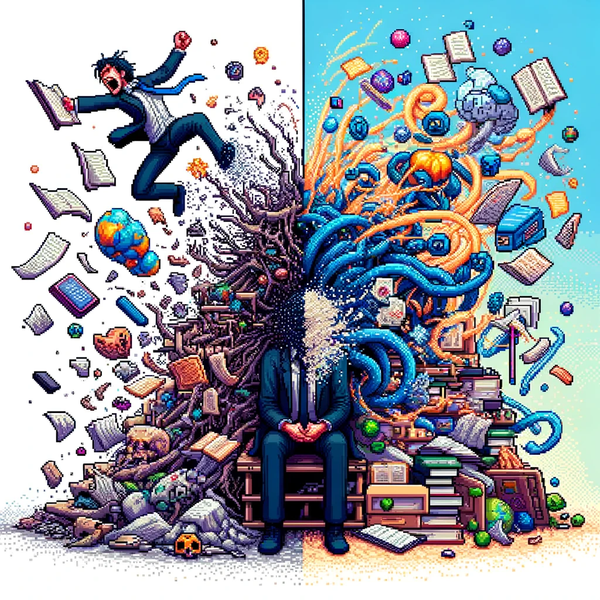
I have difficulty accepting limits and have always tried to be everything to everyone. This may happen as you age, or I have just failed enough times to finally admit I have limitations, even if I don't fully accept them. Recently, though, I found constraints to be positive.

I consistently do things I look back on later and think, “Why did I do that?" While that happens with big things occasionally, I am thinking about the small ones. I choose to watch a TV show I don't care much about instead of reading a book