Favorite Books of 2025
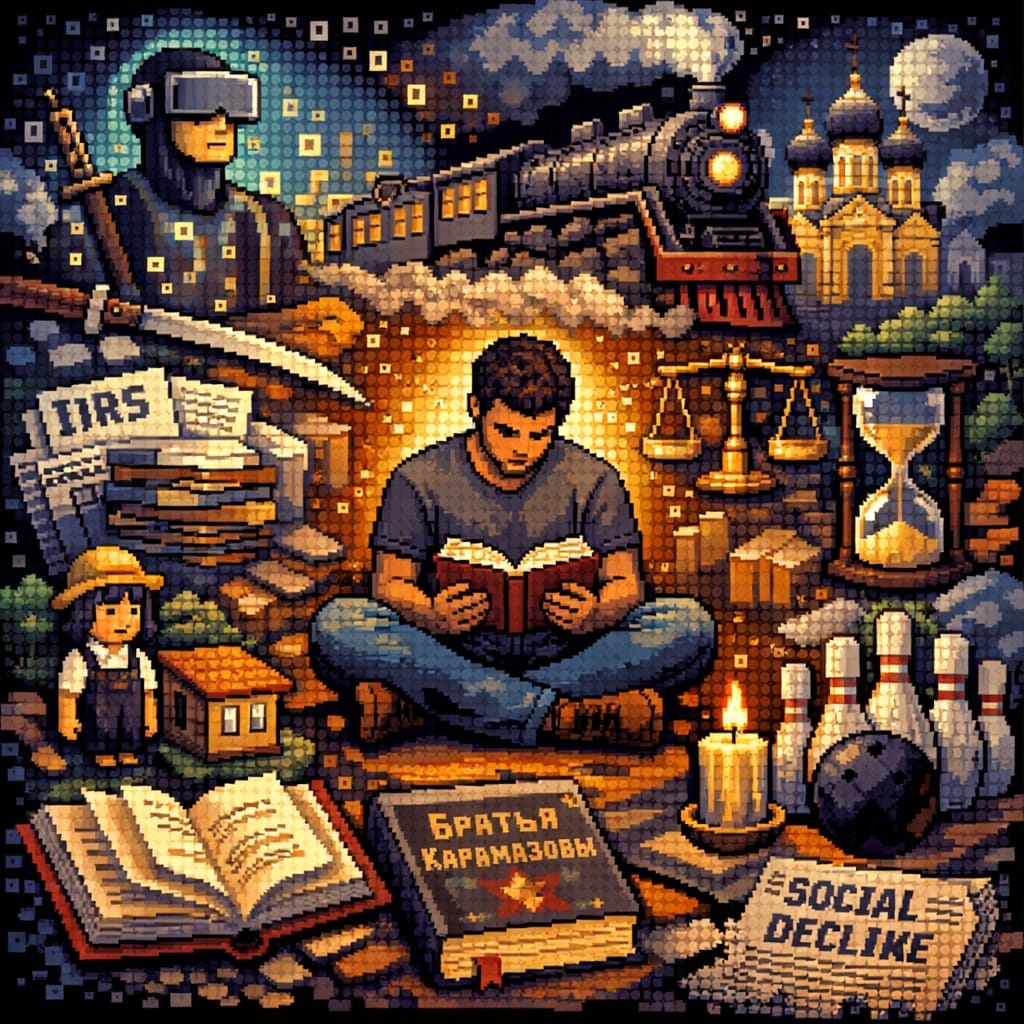
At the end of last year, I posted my favorite narrative and non-fiction books of the year. I thought this was a fun exercise, so I am back with the second installment!
First, before I get to the books, I wanted to call out that this year was special. I read more fiction than I did non-fiction for the first time in my adult life! There were a few different things that led to this shift, but the two most notable were:
- Capturing Psychological Nuance - I have always enjoyed reading about psychology, because people are fascinating. Until this year, the impact and importance of fiction in this realm never fully clicked (I knew it in my head, but didn't feel it). You can capture far more psychological nuance in a great story than you can in any academic publication. In fact, many key concepts are difficult, or impossible, to capture in standard research. Charlie Munger identified this when he was shocked that psychology textbooks didn't address envy[1]. It is such a clear driver of behavior and is part of our stories and myths from the beginning of the written word, but can be overlooked in non-fiction study alone.
- Focusing On What Doesn't Change - We are constantly overrun with information, and a good way to determine what is valuable is whether it has stood the test of time, the Lindy effect. Reading stories that have resonated with people across decades or centuries seems like a great place to start[2]. This is also a far less stressful way to live than feeling like you have to keep up constantly with the latest and greatest. There is a place for learning about new things, but it seems more important to focus on the things that are not going to change.
I thoroughly enjoyed this different focus this year and expect fiction will win out again this coming year. Let’s get into the books (in no particular order).
Fiction
Project Hail Mary by Andy Weir (2021) - This is an incredible story from the same author as The Martian and The Egg, but I don’t want to say anything about it to avoid spoilers. I read this book early in the year, and it is the one I have recommended the most over the past 12 months by far. There is a movie coming out soon, and there is a spoiler in the trailer, so if you plan to read it, don’t watch the trailer!
Something to Do with Paying Attention by David Foster Wallace (2022[3]) - A short novella about how a young man went from a self-defined nihilist to a dedicated IRS agent. The premise sounds boring, but I actually found the book to be a page turner and one that was hard to put down at times. I would say the book is the literary embodiment, in many ways, of David Foster Wallace's well-known commencement address This is Water. Over the past few months, I have frequently thought about this book. The style may not be for everyone, but if you have ever considered reading David Foster Wallace before, this seems to me like a great place to start.
Snow Crash by Neal Stephenson (1992) - This book coined the term “metaverse” and lived up to the hype! There are interesting elements that combine concepts from linguistics, with a focus on the power of language, and computer science. Since reading this book, I have been surprised by the amount I have heard it referenced or seen it discussed online, things I would have previously missed. A great piece of foundational science fiction that has some elements that feel applicable today[4].
The Brothers Karamazov by Fyodor Dostoevsky (1880) - Known by many as one of the greatest books of all time, a couple of friends and I picked this up to read something that would have been daunting alone. The book follows along with the sons of Fyodor Pavlovich Karamazov as they wrestle with spirituality and ethics after a hard upbringing. The book's storyline felt a bit meandering at points, but I thoroughly enjoyed the great exploration of spiritual and ethical questions. I still often think about many of the themes from this book. If you are interested in a compelling philosophical experience, I highly recommend giving it a read! Going through it with friends and listening along with the Creative Retrieval podcast[5] also made this much more enjoyable and helped me maintain momentum.
Non-Fiction
Totto-Chan by Tetsuko Kuroyanagi (1981) - This is a book about a girl living in pre-WWII Japan who was expelled from her elementary school for being distracting and unable to sit and do her work. She attends a new school that uses alternative methods that lean into her active nature, enabling her to be the best version of herself. I read this thinking it was a beautiful fiction story, but it turned out to be true! The book is the story of Kuroyanagi's childhood[4]. There are lots of great lessons for adults interacting with kids, being open to their ideas, letting them lean into their curiosities, and treating them with respect. One particular idea that was continuously reinforced is that if kids are struggling with behavior, they are not bad, it is likely just the environment.
Bowling Alone by Robert Putnam (2000) - Community is an undeniably important part of the human experience. Robert Putnam dove into the data to figure out why civic engagement, what he terms "social capital", is in decline. This is a book you would expect to be written today, but it was actually published right at the turn of the century, before the internet had its significant impact. Everything we feel about society fragmenting was already on this trajectory. A really interesting read that is a great explanation of the problems and some proposed causes, but sadly, there isn’t a clear solution.
Let me know if you end up picking up any of these books. I would love to discuss them with you! I hope everyone's 2026 is off to a great start.
Honorable Mentions: Remains of the Day[7] and Never Let Me Go by Kazuo Ishiguro.
- Poor Charlie's Almanack was also something I read for the first time this year. Even if you don't read the whole book, I recommend reading the talk I referenced above, The Psychology of Human Misjudgement.
- History would be the other obvious place to start, which I plan to do more of this next year.
- David Foster Wallace passed away in 2008, but this novella was complete before his passing. The story stands alone, but is also part of The Pale King, the novel he was working on at the time of his death, which was published in 2011.
- If you have read the book, I think the gargoyles are particularly interesting concepts in today's world because of AI's limitations, only being trained on digital data... If anyone wants to discuss, let me know.
- The podcast is a professor talking to his class in a liberal arts college. It isn't super polished, but the content is good, and I found it helpful as a companion to the book.
- She grew up to be the Japanese equivalent of Oprah and has been hosting her weekday show "Tetsuko's Room" for almost 50 years!
- I learned this after reading it, but Jeff Bezos said in 1998 that "Before reading it, I didn’t think a perfect novel was possible."